
Kinesio Tape, is the original elastic adhesive tape developed by Dr. Kenzo Kase in the early 1970s.
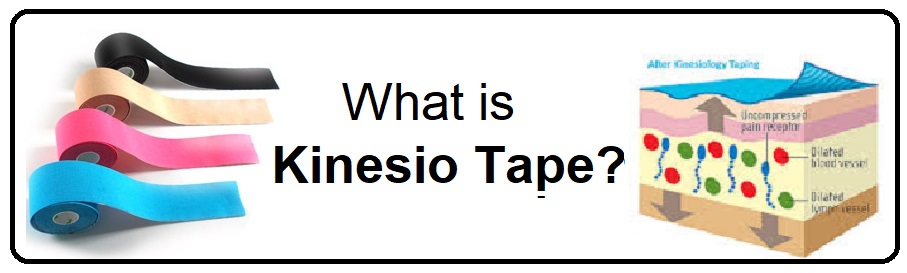
Kinesio Tape is safe enough for a baby’s sensitive skin, and gentle enough for aging individuals, flexible enough for rehabilitation, durable enough to support working muscle, joint or ligament and strong enough for athletes at any level.
In cases when the tape is applied by practitioners the tape provides optimized stimulation based on space, movement, and cooling which allows the body’s natural healing power is able to do its work.
Kinesio brand tape is the specific tool of the Kinesio Taping® Method, and the basis of the ability to tape a wide variety of patients.
Through the shared clinical experience of our trained Kinesio Taping® practitioners, Kinesio® has developed our adhesive to address a wide range of patient care needs, from pediatrics to senior citizens and everyone else in between.
Based upon years of clinical use, Kinesio Tape is specifically applied to the patient based upon evaluation. The findings of the clinical evaluation or assessment dictate the specifics of the Kinesio Tape application and other possible treatments or modalities. Kinesio Tape can be applied in hundreds of ways and has the ability to re-educate the neuromuscular system, reduce inflammation, prevent injury and promote good circulation and healing, and assist in returning the body to homeostasis.
Kinesio Tape can help alleviate discomfort and can also help facilitate lymphatic drainage by microscopically lifting the skin. This lifting affect forms convolutions in the skin thus increasing interstitial space and allowing for a decrease in inflammation, reducing pressure while enabling a more effective flow of lymphatic fluid in and out of the target area.
THERE IS A RIGHT & WRONG WAY TO APPLY KINESIOLOGY TAPE!
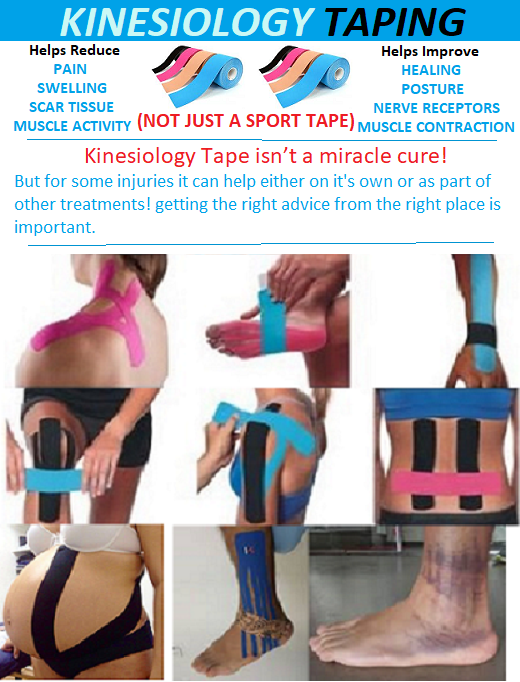
You can buy Kinesiology Tape at many shops and online at various prices and sizes. Most packs of the tape come with instructions. In some cases, people who follow the instructions and apply the tape themselves can and do find some help or relief. But there are many ways the tape can be applied, Depending on the injury.
1. Anchoring, Direction and tension of the tape is important. Should you anchor the tape at the origin of the muscle or the insertion?
2. Tension of the Stretch of the tape as you apply it to the injury is also important, too little tension might not affect the injury at all and might even cause the irritation to the nerves in the muscle which can prolong healing.
3. If the area of the injury has more than 1 muscle group, it could mean that the tape needs to be applied to just one of the muscles not the entire group.
4. Is it a muscle, ligament or tendon injury. Tape applications for these can be different.
5. It it a swelling, inflammation or bruising injury, again the tape would be cut and applied differently, which could include lymph drainage.
6. The stretch and position of the muscles, ligament, tendons and joint are also important when applying the tape.
There are many other factors to take into consideration when applying Kinesiology Tape to your personal circumstances and injury. Assessment and Finding the best taping method that helps your personal circumstances the most is important!
I personally used the kinesio tape for a knee injury, before I became a Certified Kinesio Taping Practitioner.
I followed the instructions, watched videos but didn’t find the tape worked for me. I have diplomas in Sports Therapy and Massage, and yet Kinesiology tape was new to me.
After a few weeks of trying the tape for my knee injury with not much success. I decided to go on a Certified course with Kinesio Uk. After attending an intensive weekend course, I found that I had been applying the tape to my own injury in the wrong way.
I have learnt many things about the various way the tape can be used and what it can actually benefit, and am still learning.
I have met people who tried the tape and found no benefit at all. One person I met had taped his shoulder and said he didn’t find any benefit at all. I asked him how he was applying the tape he said he followed the instructions for a general shoulder injury. I asked him how he did it and what was the injury. He said a frozen shoulder. I then explained that the way he had taped his shoulder wouldn’t help his own injury and explained a way that I would tape it. Next time I saw him he said the taping instructions I had given him had helped.
My personal opinion is there is a right and wrong way to use the kinesiology tape. If you are unsure about using the tape and applying the tape yourself, or tape you might have applied has not worked for you. I suggest you find a Qualified Practitioner. There are cases where the tape won’t work, because there may be another reason for the injury.
If applied in the wrong way it can irritate the original injury, I know this from personal experience.
CONTRAINDICATIONS For KINESIOLOGY TAPING
Some reasons to avoid kinesiology tape?
The following is a list of contraindications to using kinesiology tape:
Severe allergic reactions to adhesive tape: Kinesiology tape adheres to your skin. If you have a history of a severe allergic reaction to adhesives, you should avoid using the tape.
Open wounds: If you have an open wound or surgical incision that is not fully healed, do not use kinesiology tape. The tape could produce a situation where bacteria is introduced into the wound.
Presence of a deep vein thrombosis (DVT): A DVT is a blood clot in one of the deep veins of the arm or leg. Using kinesiology tape near the DVT can increase mobility and blood flow. This may cause the clot to become dislodged and may put you at risk for a pulmonary embolism, which may be fatal.
Infection: If there you are showing signs of infection, kinesiology tape should not be used, as this may cause worsening of your condition.
Diabetes: If you have uncontrolled diabetes, you may suffer from peripheral neuropathy, a condition where you may have altered sensation in your legs or arms. Kinesiology tape should not be used if you have diabetes, your sensation may be altered, and you may not know if the tape is causing a reaction or a problem with your skin.
Active cancer: If you are currently undergoing treatment for cancer, you should avoid using kinesiology tape since it is thought that the tape increase circulation, and increasing blood flow and nutrition to a cancerous lesion may be dangerous.
Relative contraindications for using kinesiology tape include, but are not limited to:
Skin sensitivity: If you have sensitive skin, you may use kinesiology tape, but it may irritate your skin. A small test strip of tape can be used for a short time before applying the tape to ensure that your skin can tolerate the adhesives in the tape.
Thin skin (typically seen in the elderly): If your skin is thin due to aging, injury, or as a side effect of medication use, you may wish to avoid using kinesiology tape. The tape may pull on your skin causing skin breakdown.
Lymph node removal: Some types of kinesiology tape strips are used for lymphedema and swelling management. If you have had lymph node removal, notify your physical therapist so that lymph in your arm or leg is not directed to the area where the node is absent. This could cause worsening of your lymphedema, as the excessive fluid would be directed to an area where your body could not manage it.
If you have any of these conditions that may make using kinesiology tape dangerous or risky, you should speak with your Physical Therapist or Health Professional about alternative treatments and avoid using the tape. Your physical therapist should be able to suggest other treatments that are safe for you and can help you quickly return to your previous level of function.

Before you start any diet, exercise program or take any supplements you should consult your doctor or health professional. Information on this site is based on my own personal experience and opinion.
 mikeonline.org